Now for the best part. In this chapter you will learn the basics of blues style lead playing! You’ll start with theĀ Blues scale, learn how to keep it simple and make music right away. You’ll also get an introduction to the licks, tricks and secrets of the Three Kings of Blues.
Whenever you want to learn to play a style of music, the most important thing to do is to listen to it and imitate what you hear. But in order for you to be able to imitate what you hear, you need a basic understanding of the notes and techniques that are used. The good thing about the blues is that it ultimately comes down to just a handful of notes, played in different octaves and places on the neck, and in this tutorial I will break that down for you.
If you wanna learn to play blues, you have to listen to it. But in order for you to be able to imitate what you hear, you will also need some basic skills on the guitar. So that’s what we’ll work on in this chapter! You will become familiar with the most important notes in blues soloing and learn how to “improvise” with them and make some music happen. We’re also gonna talk about rhythms, phrasing and playing with “feel”.
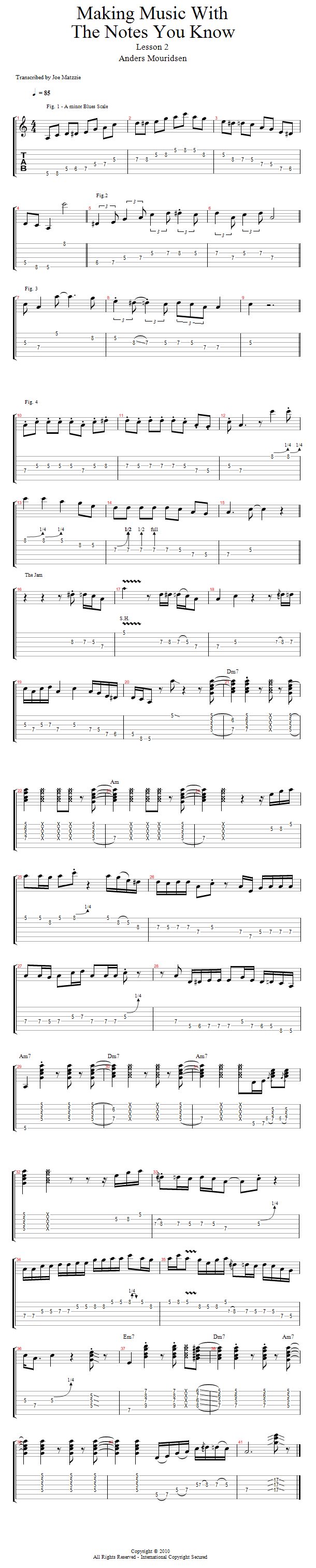
A scale really is nothing but a collection of notes that you can pick and choose from when you improvise. In this lesson I’m gonna show you a really useful collection of notes, called the “pentatonic scale”, and after that I’ll teach you what’s called a “lick”. And a lick is just an example of something musical you can play using these notes. Kinda like the notes were words in a foreign language and the licks were sentences. So it’s time to make your first pentatonic sentence!
In this lesson we’re gonna add an extra note to the pentatonic scale that you just learned. This extra note will give the scale more of a bluesy sound, and that is why people call this collection of notes “The Blues Scale”. I will also show you a lick that is very similar to the one from the previous lesson but incorporates this new and bluesy note.
One of the cool things about the guitar is that the same note can be played in several different places on the neck. This can be pretty confusing, but once you get over that it opens up a world of possibilities. You will no longer be stuck in the first scale pattern you learned- you will be able to move around and use your ear to navigate through different positions and patterns on the neck.
But it takes time to get comfortable with this, so don’t expect it to happen overnight. Just watch this video and try to become aware of this concept, so you can start working on it!
I know it might seem overwhelming how the scales cover the entire fretboard, the fingering, terms like scales and licks etc. But if this tutorial has shown you that blues soloing ultimately comes down to just a handful of notes and what you do with them, you’ve come a long way! This was just an introduction to some concepts that you will need later on like playing in different positions and learning licks. We will revisit all of these as we go on with the blues!
In this tutorial we’ll explore different “micro positions” or “blues boxes” all over the neck and make some music with the notes that we find. Aside from claiming new territory on the neck, you’ll be introduced to the concept of improvising and some useful things to keep in mind when you do this! Whether you wanna play blues, rock, funk, jazz, or even polka this is a great place to start.
At this point you’ve learned to play some notes in the A minor blues scale, and now it’s time to make some music with the notes that you know. Don’t worry if you only feel comfortable with a couple of notes at this point, because we’re gonna take one “micro position” or “blues box” at a time and go through it before we start to play. Then we’ll go back and forth between me playing and you playing so that you can start to make your lead playing sound like blues and start to realize how much fun improvising really is!
We’re gonna start out in the good ol’ familiar pattern of the A minor blues scale and try to do some “improvising”.
Improvising is all about trying out everything and then remembering the good stuff. So don’t worry about playing bad notes, because if you’re just starting out, you need to play about 50 bad notes to find one good one! Have fun!
In this lesson we’re gonna explore a different “blues box” that many guitar players refer to as the “Albert King Box”. Once again, a “blues box” is a place on the neck where you can play a couple of bluesy notes- not a whole scale pattern or anything like that. That’s why it’s also referred to as a “micro position”.
I’ll show you how to find this blues box from your familiar pattern of the A minor blues scale, and we’ll go through the notes and how to use them before we start playing.
Also in this lesson, we’ll go back and forth between me playing four bars and you playing.
In this lesson we’ll use the technique that we covered in the tutorial “Getting Familiar With The Most Important Notes” to find a new “blues box” or “micro position” of the A minor blues scale. The technique is to play the blues scale on one string and then stop somewhere to find a couple of cool notes around it. Then, once we’ve broken down this “blues box”, we’ll take turns soloing for four bars with the backing track.
When you really wanna “tear it up” it works really well playing the familiar pattern of the blues scale UP AN OCTAVE! You can play the same licks and they will have a very different and cool sound. You will most likely have to consider some alternative fingering, because the frets are so small up there. Once I’ve shown you how to find this pattern, we’ll take turns playing four bars with the backing track.
So far we’ve stayed in just one blues box for each of our “jams”. Now it’s time to try and mix them all up. Try to get loose with it and take some chances- go where you DON’T feel comfortable and make it yours! What better time to expand your vocabulary than right now?!
In these lessons we’ve been all over the neck and made some music with all the notes that we found. Don’t stop here! Keep exploring and expanding these micro positions and get comfortable finding your way in and out of them. And in the future, if you should see me or anyone else play in a position you don’t know you’ll have some tools you can use to find it and make it your own!
BONUS TIP: In this tutorial we used the technique of playing scales on one string to find new Blues Boxes, but you can also find them from chords that you know. For example, what we called the B.B. King Box is right where you play the A minor barre chord with the root on the 5th string. That’s another way to find it!
In these lessons I will introduce you to some really useful techniques like bending, vibrato and hammer-ons and pull-offs, so that you can start working on your feel. Great feel doesn’t come from these techniques alone, but learning them will help you get in touch with that side of blues playing.
Blues is all about expressing your feelings through your instrument, but how do you learn and practice that?
You can’t teach someone to play with feel, but you can teach some techniques that can be used to get in touch with that side of things. Getting comfortable with techniques like bending, vibrato and hammer on’s and pull off’ require a lot of hard work, but will ultimately make your playing sound much more expressive and soulful!
The Blues was invented by singers, so anytime we improvise on the guitar we are actually imitating a singer. And one of the key elements in this is bending the notes. In this lesson I will show you how to bend, what to watch out for when you do it, how to practice it and finally I will demonstrate how bending sounds in a blues context!
Another vocal technique that we can use in our guitar soloing is vibrato. Vibrato is such a huge part of someones “signature” sound and can make the difference between sounding like a beginner or like a blues guy.
And even though it requires a lot of practice to develop a good vibrato, it’s important to be aware of how much it can do for your playing! In this lesson we’ll talk about the different kinds of vibrato that people use, how to practice them and finally we’ll try it out with the backing track.
When you hear a singer sing or a person talk they don’t accent every word in the sentence. This also applies to guitar soloing, where you sometimes want to avoid picking every note. This can be done by using a technique called “pull-offs”, and in this lesson I will show you how to do a pull-off and demonstrate how it sounds in a blues context.
The “hammer-on” is basically the same technique as the “pull-off”, but the other way around. Once you get this technique down, you can combine hammer-ons and pull-offs to get a more vocal-like phrasing and also to be able to play faster than your right hand can pick.
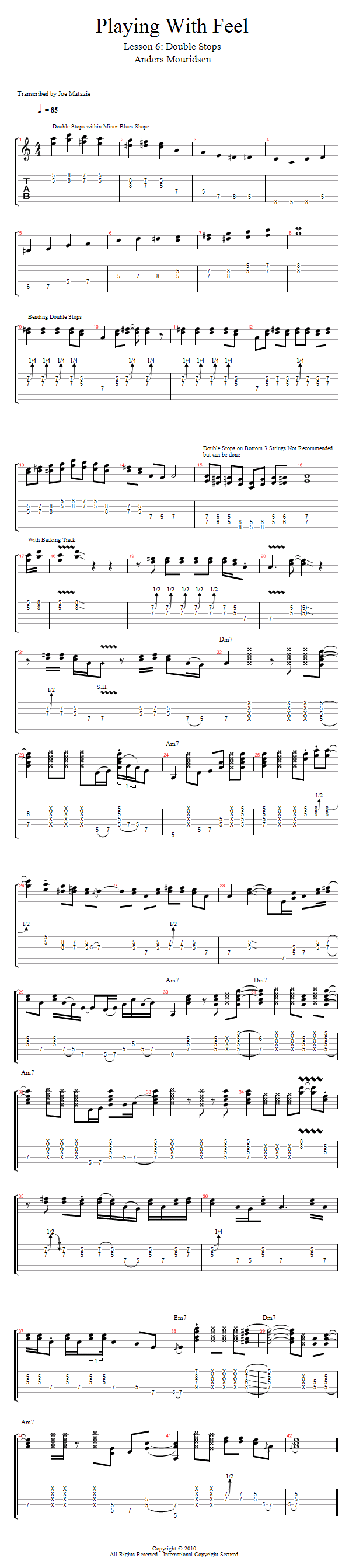
In this lesson we’re gonna experiment with the sounds that you get when you play two notes at a time in a lead context. After we’ve looked at the basic technique and note choice, we’re gonna try it out with our backing track.
By now you should have an idea of how much these simple techniques can do for your playing. So start working on them, and remember that it takes a lot of hard work to build up the necessary strength and muscle memory. So don’t be discouraged if you hit the wall a couple of times; just keeping running into it, head first, and eventually you’ll get through!
The old blues guys made music history with just a handful of notes, so there are obviously a lot of other elements to a great blues solo than just great note choice. There is the “feel” that we covered earlier, the tone of your gear, which you will learn about later, but most importantly there is the rhythm and timing of your licks and notes. This is the concept that, above all the others, will make you sound like a blues guy. So in this tutorial we’re going to experiment with the sound of different “subdivisions” and timing concepts.
Playing great blues doesn’t have much to do with the actual notes you play- It’s all about HOW you play them and WHEN you play them. In the previous tutorial we talked about HOW you play the notes with techniques like vibrato, bending and all that. Today we’re gonna dive right into the WHEN with the concept of timing and rhythm in blues soloing. This is in my opinion the most important element, and hopefully by the end of this tutorial you’ll have a good understanding of how much this concept can do for your playing, so you can start working on it!
Anytime you have a groove that you wanna solo over, you have a choice of what “subdivision” to play. And the term “subdivision” is just a fancy word for how many notes you want to squeeze into one bar.
Ultimately you wanna be able to switch between all of these subdivisions when you improvise, but in today’s lessons we’ll take them one at a time and try to experiment with the effects and sounds that they have.
In this first lesson we’ll look at the slowest subdivision, which is the “whole note” meaning one note per bar, and try to improvise with this slow phrasing.
In this lesson we’ll experiment with the sound of the quarter note phrasing. You have four quarter notes per bar- one per “count”- so it’s a faster and very useful rhythmic phrasing. Try it out!
In this lesson we’re gonna explore the sound of the eighth note phrasing.
Eighth note phrasing is very useful and you’ll hear all the great blues players use this rhythmic phrasing.
When you have three notes per quarter note, we call it “triplets”. In this lesson we’ll explore the sound of the triplet and try to make some music happen!
In this lesson we’re gonna try to mix up all the subdivisions that you’ve learned today. This can be very hard to do, so start with just one single note and then once you’re comfortable switching between the subdivisions, add a couple notes and so on. Just remember that you gotta walk before you can run! So keep it simple at first!
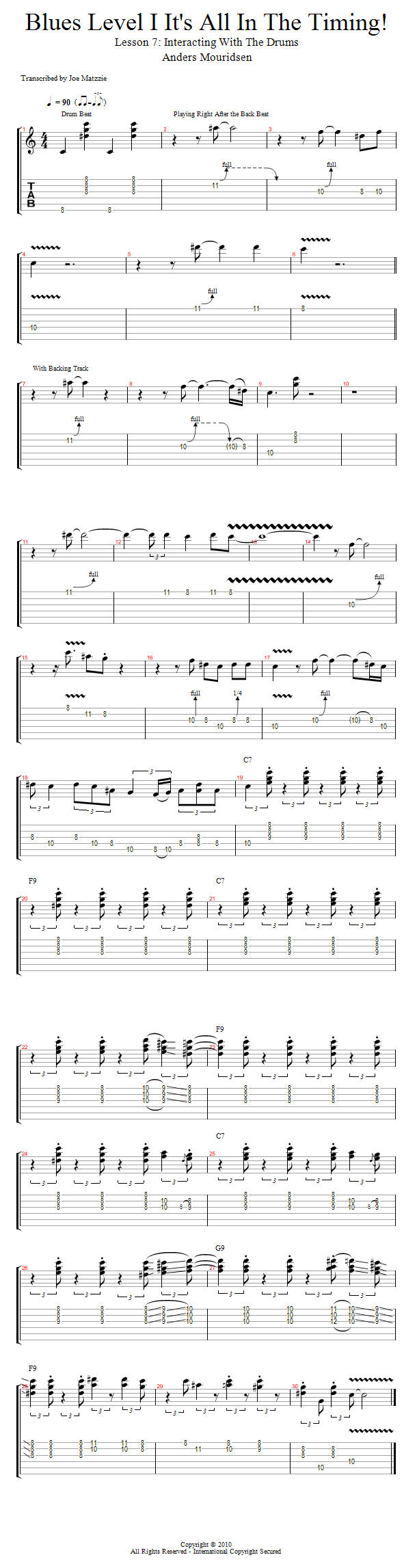
In this lesson we’ll look at a concept that doesn’t have to do with the subdivisions, but with the drum groove. This is a very useful concept that Stevie Ray Vaughan uses a lot, where you play the note right after the snare drum hits. Check it out!
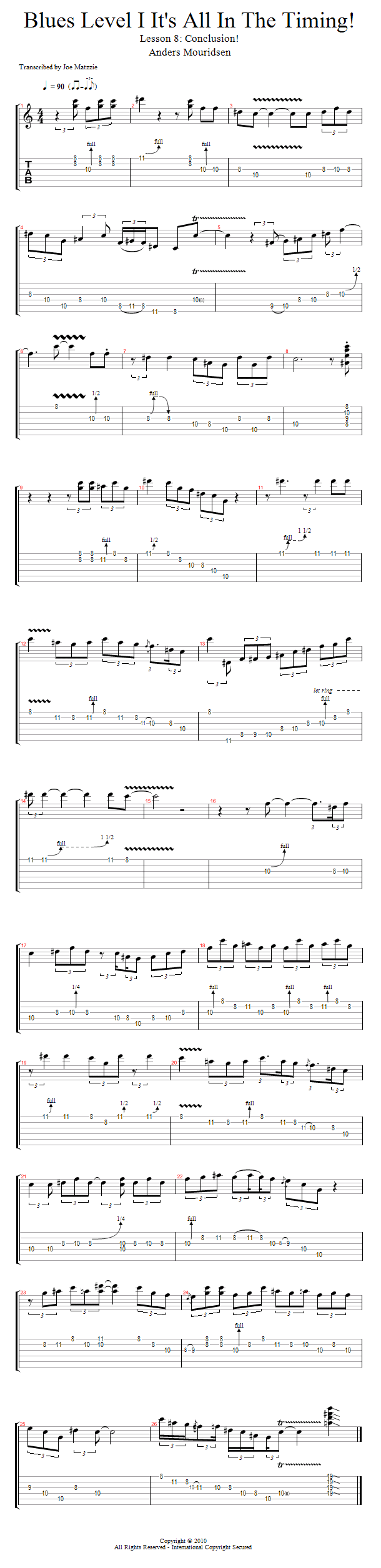
In this lesson I’ll summarize everything we’ve covered today and then play a little bit for you with the backing track. Just for fun and hopefully for inspiration! Thanks for watching!
In this lesson we’ll summarize everything that you’ve learned in this chapter:
1) Good notes! We worked on finding good bluesy notes all over the neck.
2) Expression and Feel! We worked on techniques like hammer-ons and pull-offs, bending, and vibrato.
3) Rhythm and timing! We worked on using different subdivisions when you improvise and how to use the drums as a reference point.
Continue working on all 3 elements and listen for them when you listen to your favorite blues records. That’s the best way to improve!